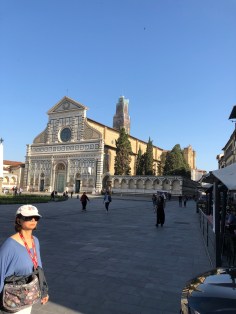
 Florence, or Firenze in Italian, is a compact city that would take weeks to uncover its many treasures. Unfortunately, we only had a day. The city is best known as the birthplace of the Italian renaissance, and I for one, would exponentially increase my knowledge of this period as we toured its streets and museums. We began bright and early with a walking tour that started at the Piazza di Santa Maria Novella. Our Florence guide, Ricardo, noted the facade of the basilica was a that of a typical renaissance church. This was much different than the Baroque churches we’d seen in Rome or the Gothic church in Assisi.
 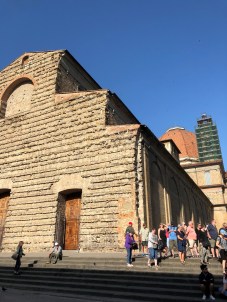 The facade was just a flat layer of marble attached to the front of the building that resembled a school child’s drawing of a church. On our way to the Academia Gallery to see the David, our guide walked us past the Basilica di San Lorenzo which didn’t have a facade. Its face was a bare block wall with three wooden doors. From the front, you would never know it was a church. But this is way too much exposition about Renaissance church construction for this blog post. This is why Janet says I’m full of totally useless information.
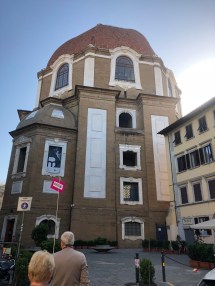 Our guide also pointed out the Cappelle Medicee at the rear of San Lorenzo as the tomb of the Medici family, and around the corner the Pallazo Medici Riccardi, the home of the Medici’s. I’d heard of the Medicis but I confess, I knew very little of their history and influence before today.
 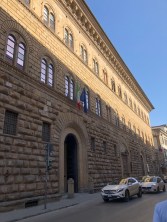 As I learned throughout the day, everything we saw in Florence was a result of this family’s influence. Their governance, and patronage of the arts and architecture moved Florence from a feudal kingdom, to one of the most powerful city-states in Italy of the middle ages.
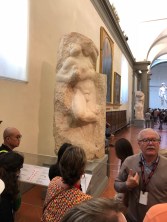 At the Academia gallery our guide shared with us Michelangelo’s life and work while describing the four statues known as the Prisoners, or Slaves. These unfinished works exemplify how he would move from project to project, often leaving works only partially complete.
 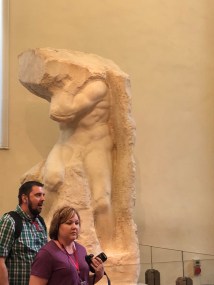 You get to see the different phases of the process Michelangelo described as freeing the prisoner locked inside the rock. He believed his job was to remove all that was unnecessary, and what was left was the image that was there all the time. Janet felt this was her favorite part of the day and marveled at the master’s technique.
I’m a musician, and am frequently brought to tears by the melodies and harmonies combined to evoke an emotional response. Visual art rarely affects me in the same way as music. However, our guide was a master of interpretation, and the David seemed to be his thesis. His description of the eyes gazing into the future, not being shackled by the dogmas of the past, the over-sized hands prepared to accomplish the task, and the exhibition of human perfection and potential really struck a chord in me. We walked and talked around the entire statue and I admit, my eyes were filled with tears as I was enthralled by it all.


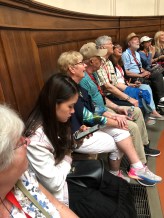
Apparently, not everyone appreciated the moment as I did. At one point, our group was seated behind the statue learning more of this incredible work. I couldn’t help but notice a young woman from another group seated among our comrades gazing at her phone while surrounded not only by one of the most famous pieces of art, but indeed an entire gallery of incredible work. I guess I’ve now risen to the level of art snob.
Time was fleeting and we left the Academia to view the dominant structure of the city, the Cathedral of Santa Maria del Fiore. This church is famous for it’s dome, which was the largest in the world until modern times. It was also the first dome constructed of this magnitude since ancient Rome. Covered in white marble with green and black inlaid design, the outside of the cathedral is quite impressive. We didn’t have time to go inside or up to the dome, but maybe that will be a quest for another trip. Opposite the Duomo (Italian for cathedral) is the Baptistery of St. John. Parishioners were not allowed in the cathedral unless they’d been baptized, so the baptistery was placed outside the church in many medieval cathedrals. It too, is covered in the same ornate white, green, and black marble. The east doors are what many people come to see. A series of 10 panels carved in gold relief by the artist Lorenzo Ghiberti depict scenes from the Old Testament, and is credited for being one of the first works of art to use the technique of perspective to display depth.


We moved on from the Duomo to the Palazzo Vecchio where our tour would end. Again, time did not permit us to enter the palace, which was the seat of government during the Renaissance. Here was where the Medicis and their counterparts ruled the city-state of Florence, and was the center of the city’s activity as opposed to the church. The Piazza della Signoria in front of the Palazzo was a virtual outdoor museum containing at least a dozen gigantic statues including a replica of the David to replace the original, where it once stood. Opposite David was an equally impressive Hercules.


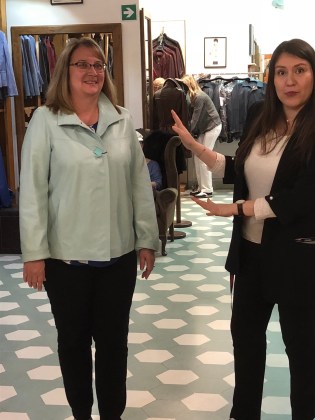 Florence is known for its leather and jewelry. As our Italy tour progressed, we noticed that Gate 1 and other tour guide companies had partnerships with local vendors. Restaurants and shops often thrive on the recommendations of these partnerships, and today we found ourselves in a leather shop for a tutorial on selecting quality leather, and a fashion show featuring some of our travel mates. Janet modeled a beautiful aqua colored jacket that I would have gladly purchased had it not cost over 500 euros. The stop was worth it for the shop as many of our tour walked away with new leather apparel.
As beautiful as Florence was, I must confess that because we were in a hurry to get to the Uffizi gallery, we scarfed down the worst frozen pizza for lunch. It was free, and quick, and we knew that tonight we would be treated to a feast. I’ll leave shame for another day.
We met our new guide, Cindy on the steps of the Uffizi gallery. She was our morning guide, Ricardo’s, wife , whom she’d met years ago while studying art in Florence. Janet and I are both education professionals and have many “shop” talks at home. We jokingly call it our private professional learning community (PLC). After being with these two all day and listening to their breadth of knowledge, I can imagine they too have their own private PLC.
How much art can you see in one trip and not be overwhelmed? I think we tested the limits. The Uffizi gallery contained some of the most incredible works of art I’ve ever seen. Boticelli was certainly my favorite artist of the afternoon with both the Primavera and Birth of Venus beautifully displayed in airtight casing. Unlike the Mona Lisa in the Louvre, these rooms weren’t as crowded and visitors could stand and appreciate the art. The museum is one of the world’s largest so we only were able to see the highlights, including works by daVinci, Michelangelo, and Raphael. The only turtle missing was Donatello. (Little humor, very little) But it truly was a feast for the eyes.


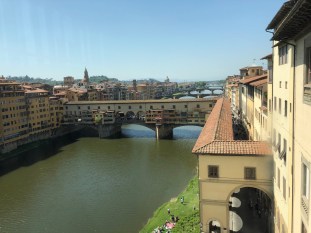 At one point we were able to see the walkway that went from the Pallazo Vecchio across the Ponte Vecchio and to the other side of the river. This was how the Medicis were able to travel from the Pallazo to their home across the river without mingling with the common crowd. Our guide told us that the Ponte Vecchio (bridge) used to contain stalls for butchers, but in the summer the smell became unbearable for the Medicis to pass over. So they outlawed the butcheries and replaced them with jewelries, which still stand today.
After the tour, we were given free time until dinner. Janet and I made our way to the Ponte Vecchio and were amazed at the number of big name jewelers displaying their wares. After our cruise in St. Thomas, we knew better than to even get near one of their stalls. We took a leisurely walk beside the Arno river and enjoyed a little time away from the crowd. Spring was in the air, and some of the restaurants had beautiful floral displays for their outdoor dining.


We were promised a feast for dinner, but I could not have begun to imagine the experience we were to have. Our bus took us up and out of the city into the hills of Tuscany to an old farmhouse that has been converted into Ristorante I Tre Pini. Though the inside was beautifully appointed in traditional Tuscan decor, we were thrilled to be led out to the patio for a dinner under the stars and Wisteria covered arbors.


After a toast to the evening with a blue colored wine cocktail, the meal began with a table of 17 appetizers. It was followed by entrees of our choice, and Tiramisu for dessert. Live music, unlimited wine, and dancing made this one of the most magical of all our experiences in Italy. Many of Gate 1’s reviews include people describing this as their favorite moment of the trip, and it’s easy to see why.
I didn’t think anything could match Rome for all there was to see, but not only did Florence contain a treasure trove of things to experience, it maintains a small city atmosphere that makes you just want to come back as soon as you can. We enjoyed food, wine, art, history, and each other. For me, it was a perfect day.
“Life is either a daring adventure or nothing at all.” – Helen Keller
 Living in New England Like a Tourist