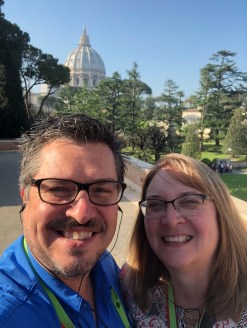
 With Imperial Rome behind us, Day 2 began with our tour of the Vatican. It was another early morning so that we could beat the crowds and see everything on our agenda. Maurizio and Christine, our Rome guide met us at the bus for the day’s adventures. Our Vatican experience can easily be divided into the Vatican museums, and St. Peters.
The Vatican museums are huge. National Geographic lists it among the top ten museums of the world. Our tour was limited to some of the highlights that could be seen in an hour and a half, but what we saw was phenomenal. We saw many of the “must-see works including the Pineapple courtyard, the statue of the Trojan priest, Laocoön and his sons being strangled by snakes, the Apollo Del Belvedere, The Rotunda room, the tapestries hall, and the maps room. I could have spent at least a day or two just in these museums. I wanted to see Raphael’s School of Athens, but our tour was just too quick.


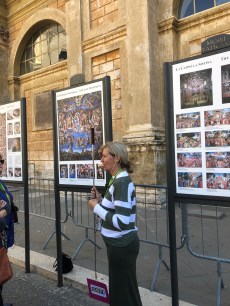
Of course, our tour of the Vatican Museum concluded with the Sistine Chapel. No pictures are allowed in the chapel, and people aren’t supposed to talk. In order to talk about Michelangelo’s ceiling and wall, our guide was able to utilize signboards in the Pineapple courtyard to point out details not to miss. The chapel is all anyone says about it and more. Pictures may detail the art, but cannot convey the experience of standing in this place with such significance. Regardless of a person’s belief structure, it is truly a spiritual experience.
After exiting the chapel, we made our way into St. Peter’s Basilica. Upon entering the great doors, you can’t help but be impressed by the incredible size of St. Peter’s, the largest catholic church in the world. Down the center of the nave is a line that marks sizes of major cathedrals and basilicas throughout the world. I always thought St. Patrick’s in New York was so large until we were directed to its marker which lay about 2/3 up the line. The basilica is filled with beautiful statues and mosaics including Michelangelo’s Pieta, one of the highlights for me. The altar was a work in itself made of marble and gold covering the tomb of St. Peter himself. One of the most interesting things we learned about Rome is how the marble was recycled from place to place. Much of the marble used in St. Peters came from the Colosseum and forum.


Our time in St. Peter’s was short but memorable. We exited to St. Peter’s Square for beautiful views of the basilica, the obelisk, and the famous fountains.


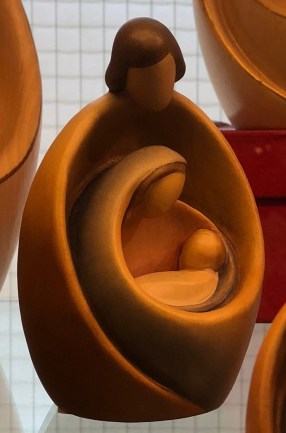
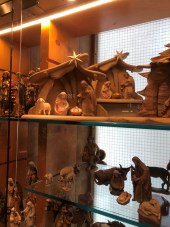 Our next stop was a Vatican gift shop just off the square. I need to explain here that Janet collects nativities. To date she has 20 that we display every Christmas. The gift shop contained many wonderful mementos, but we gravitated to the display cases filled with beautiful and unique nativities. Though there were a few we really liked, we settled on one carved from a single piece of wood.
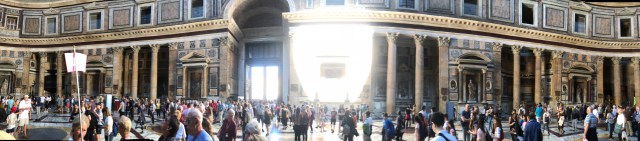
Our Vatican experience was complete, but our day had only just begun. Again, we opted for an additional excursion called the Piazzas and Fountains of Rome, a half day walk through many of the most pictured spots in Rome. Our tour began at Piazza Navona. Once a Roman circus, this is one of the largest of Rome’s piazzas. The former race track is now lined with restaurants, gift shops, churches, and artists kiosks. Three beautiful fountains command your attention as you enter the piazza and each contain stories about the artist and their work. We ate lunch here before moving on to our next destination, the Pantheon. Like the day before, we were transported back almost 2,000 years into the oldest continuously used church. Once a temple to all the gods, it was transformed into a catholic church after the fall of Rome. It’s only source of light is a hole in the ceiling called the oculus.


After leaving the Pantheon, we saw a modern building that incorporated the columns of an ancient temple, and a renaissance palace that had been converted into a mall. Our guide reiterated the recycling nature of the city, rather than tearing down and rebuilding. We also traveled through a fantastic alley filled with shops and eateries. Here we learned how popular Pinocchio is to Italian culture.


Do a Google image search for Rome and Trevi Fountain will undoubtedly be on the first page of pictures. This work of baroque art is attached to a building that lies at the intersection of three roads, hence the word Tre Vie (Three Roads). This intersection forms the piazza surrounding the fountain which is relatively small compared to the massive size of this magnificent fountain. We spent about a half hour here, throwing our coins in the fountain and enjoying gelato compliments of Gate 1.


Our final stop on the excursion was at the Spanish Steps. These steps were made famous in the movie Roman Holiday with Audrey Hepburn and Gregory Peck. The fountain in the piazza is in the shape of a boat, and many children were playing in the water. We were fortunate to be there during the annual flower festival, and the steps were highlighted by the fuschia colored bouquets lining the sides. On a sad note, we had to say goodbye to our excellent guide, Christine, who made all these sites come alive!


A taxi took us back to the hotel for a short rest before the evening’s entertainment. As part of the tour we were treated to night of light Italian opera favorites by a troupe of serious and comedic singers over another great Roman dinner. Audience participation included me as the dancing partner for a soprano/tenor marital squabble duet. Even Janet, whose doesn’t usually attend classical vocal music, enjoyed this night of music and fun.


Our tours of Rome were now complete, and we slept well to prepare for the remainder of our week. Our trip is designed to see as much as we can in a short amount of time, in case we’re not able to return. I hope the legend of the Trevi fountain is true, and someday I’ll come back to see more of this eternal city.
“Life is either a daring adventure or nothing at all.” – Helen Keller
 Living in New England Like a Tourist